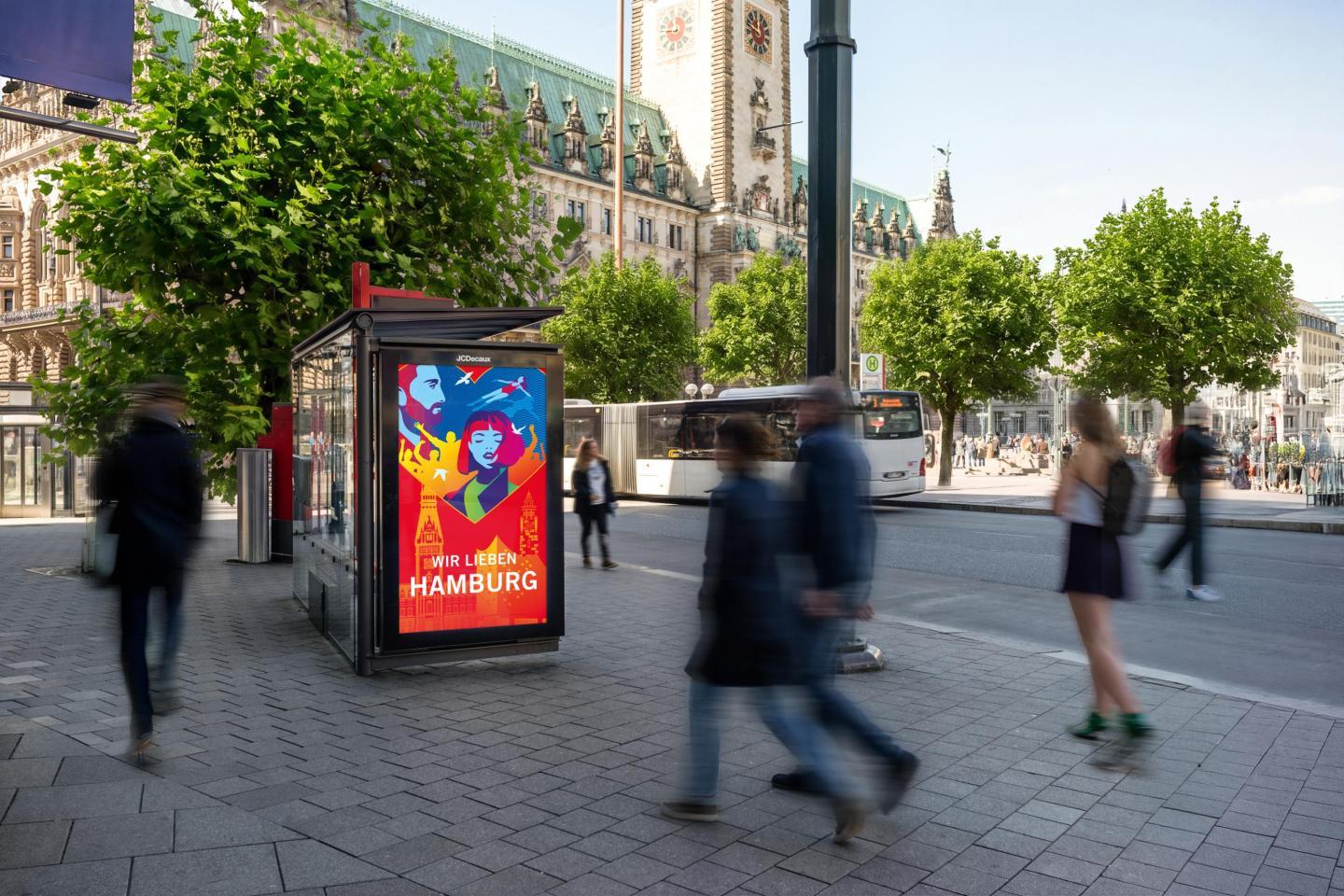

Hamburg is preparing to extend one of Germany's most established advertising-funded street-furniture partnerships for another 15 years. The decision is important not simply because it preserves a large urban advertising estate, but because it illustrates how the most valuable city OOH contracts combine media rights with long-term public infrastructure, maintenance and environmental commitments.
JCDecaux announced on August 11 that its subsidiary Wall GmbH had won the competitive tender for Hamburg's main advertising contract. The award remains subject to approval by the Hamburg Parliament, expected in September 2026.
The contract covers approximately 2,200 bus shelters and 1,710 analogue and digital two-square-metre City Light Poster advertising panels. It also permits the continued digitisation of the portfolio and calls for 400 additional bus shelters over the contract period.
For advertisers, the headline is a large, established street-level network in Germany's second-largest city. For the wider OOH market, the more useful lesson is that urban media concessions are won and renewed on more than audience delivery.
What the Hamburg contract includes
Wall and Hamburg have worked together since 1982. That continuity matters because the street furniture already in place has been maintained over a long operating cycle. JCDecaux says approximately 2,200 shelters installed 15 years ago will remain in service rather than being replaced wholesale.
This is not a small operational detail. Reuse can reduce construction disruption and avoid the material and carbon costs of an unnecessary full-estate replacement. It also gives the incoming contract period a stable base from which new shelters and digital panels can be introduced.
- Contract duration: 15 years
- Existing bus shelters: Approximately 2,200
- Analogue and digital advertising panels: 1,710
- Standard advertising format: 2 sqm City Light Poster
- Additional shelters planned: 400
- New shelters with green roofs: 100
- Wall's city fleet commitment: Fully electric by 2028
- Final status: Subject to Hamburg Parliament approval
Why this is more than an advertising-rights renewal
Street-furniture concessions typically sit at the intersection of several objectives:
The Hamburg award reflects this wider exchange. Commercial advertising helps finance shelters and their upkeep, while the operator receives access to a large urban media environment. The 15-year term provides the time needed to recover capital investment and plan the estate as a network rather than a collection of short-term placements.
That structure also explains why urban OOH tenders can be difficult to assess using media revenue alone. The winning offer must work as infrastructure, operations and advertising at the same time.
- The city needs reliable passenger infrastructure and maintenance.
- The operator needs sufficiently durable advertising rights to fund equipment, installation and service.
- Advertisers need a consistent, visible and measurable network.
- Residents need furniture that works safely without creating excessive visual clutter.
What further digitisation could mean for advertisers
Hamburg was an early European market for digital two-square-metre panels in public space, with the partnership introducing digital street-level advertising in 2015. The renewed contract enables additional digitisation, although the announcement does not provide a final count, rollout schedule or programmatic availability for new screens.
Buyers should therefore avoid treating “continued digitisation” as confirmation that every panel will become digital or automatically tradable through a DSP. The practical questions remain asset-specific:
Digital expansion should improve creative flexibility and allow campaigns to respond more quickly to time, context and location. But its value will depend on where screens are installed, how they are packaged and what delivery data accompanies a buy.
- Which panels are digital during the requested campaign dates?
- What are the screen operating hours and motion rules?
- How long is each creative slot and what share of voice is guaranteed?
- Can the inventory be bought directly, programmatically or through both routes?
- What audience currency and geographic definitions are used?
- How are outages, public messages and make-goods handled?
Sustainability is becoming part of the OOH product
Hamburg placed notable emphasis on sustainability in the tender. The announced commitments include retaining the existing shelter base, adding 100 shelters with green roofs and moving Wall's operating fleet in the city to electric vehicles by 2028.
Green-roof shelters are not a media-performance feature in themselves. They are part of the public-value case for maintaining advertising-funded infrastructure in dense cities. For operators, that matters because future concessions will increasingly be evaluated against environmental performance, biodiversity, energy use, material life and operational transport—not only revenue or screen quality.
Advertisers should still request specific evidence before attaching sustainability claims to a campaign. A citywide contract commitment does not automatically establish the carbon footprint of an individual placement. Useful proposal fields include screen energy consumption, electricity source, printing and substrate, installation travel, material recovery and the methodology behind any emissions estimate.
What buyers should take from the renewal
The contract creates long-term continuity in a major German media market, but it does not replace a live campaign proposal. The public announcement contains no rate card, availability calendar, audience delivery by asset or final digital inventory map.
A serious Hamburg plan should therefore separate four layers:
Decide whether Hamburg is being used for broad urban reach, commuter frequency, retail proximity, tourism, a district-specific objective or part of a multi-city German campaign.
Identify the exact balance between analogue City Light Posters, digital panels, shelters and any larger or transport-related formats. Do not accept “Hamburg street furniture” as a sufficient unit description.
For analogue media, confirm panel count, posting period, rotation and production. For digital media, confirm spot length, plays, loop, dayparts, operating hours and guaranteed delivery.
Require an asset list, dated photography or mapping, proof of posting or play, and an audience methodology that matches the purchased inventory.
- Market role: Decide whether Hamburg is being used for broad urban reach, commuter frequency, retail proximity, tourism, a district-specific objective or part of a multi-city German campaign.
- Network composition: Identify the exact balance between analogue City Light Posters, digital panels, shelters and any larger or transport-related formats. Do not accept “Hamburg street furniture” as a sufficient unit description.
- Delivery: For analogue media, confirm panel count, posting period, rotation and production. For digital media, confirm spot length, plays, loop, dayparts, operating hours and guaranteed delivery.
- Verification: Require an asset list, dated photography or mapping, proof of posting or play, and an audience methodology that matches the purchased inventory.
The wider significance for European city media
Hamburg's renewal demonstrates why well-maintained urban estates can outlast several technology cycles. The underlying value does not come only from replacing paper with screens. It comes from controlling a coherent network of public locations where people repeatedly wait, walk, transfer and travel.
Digitisation can make that network more flexible, but the durable competitive advantage is the concession itself: long-term access to city space combined with an obligation to maintain useful infrastructure.
For cities, the challenge is to secure public value without allowing commercial screens to overwhelm the streetscape. For operators, it is to finance service, innovation and maintenance across a long term. For advertisers, it is to distinguish the fame of a citywide contract from the actual delivery of the panels in a campaign proposal.
 London