

1 October 2026 edition | Delhi, India
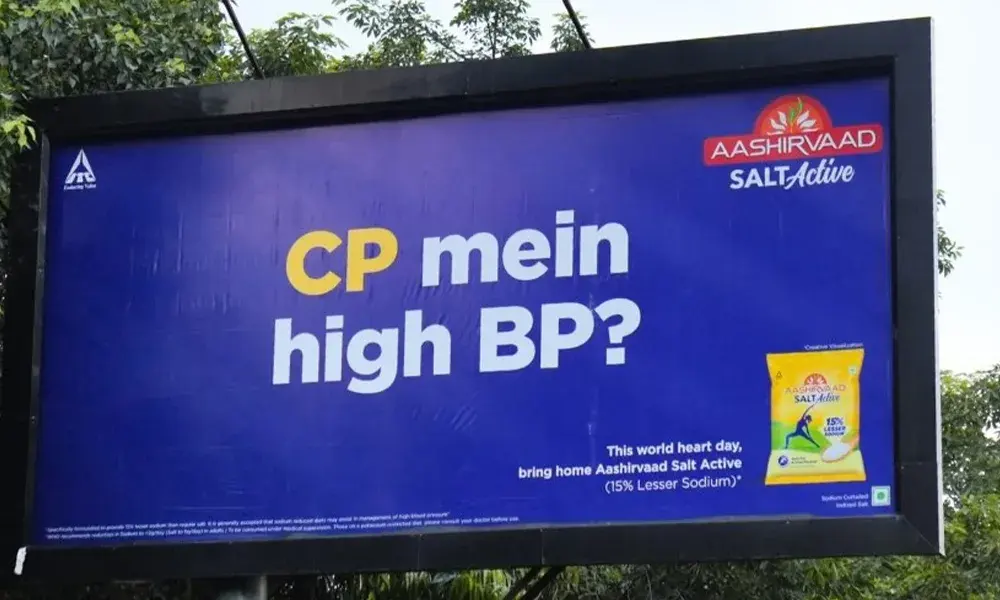
Aashirvaad Salt Active has brought a neighbourhood-led outdoor campaign to Delhi, using local references to connect its brand message with the places where people see it.
Media4Growth’s 1 October report identifies hoardings in Connaught Place, Kalkaji, Janakpuri, Shadipur, Defence Colony and Dilshad Garden. The campaign ran around World Heart Day on 29 September; the report’s publication date is not an independently verified launch date.
The creative includes neighbourhood-specific wordplay and promotes the product’s stated lower-sodium proposition. This is a report on advertising execution, rather than an assessment of the product’s health effects. The available campaign report provides no independently verified sales or brand-lift results.
Local references give the message a place
BillboardGuide’s analysis: The creative premise depends on recognition. Someone familiar with a neighbourhood name can understand why a particular execution appears there. That makes the location part of the idea, rather than simply a place to display a generic advertisement.
For advertisers considering a similar approach, local relevance should start with a specific audience and setting. A neighbourhood name added to a national headline is not automatically a useful adaptation. The language, reference and main message should work together at the speed at which the audience encounters the site.
BillboardGuide’s media planning guide can help connect that creative decision to the geography of a campaign. The proposed inventory should show where each version will appear and why that area matters to the brief.
Match each headline to its booked site
Multiple local versions create a production task as well as a copywriting opportunity. Keep a clear schedule linking the artwork filename to the location, face and posting period. A strong local line loses its purpose if it is installed in the wrong area.
Review each adaptation separately for readability. Wordplay can reward attention, but the advertiser still needs its brand and essential message to register within the viewing opportunity. A version that reads well on a laptop may become difficult to understand at roadside distance.
Use BillboardGuide’s creative checklist to examine contrast, hierarchy and text size. Any product comparison appearing in the advertisement should also retain the substantiation and qualification approved for that creative.
Measure recognition alongside delivery
A local campaign can be assessed through posting records, site photographs and a defined audience estimate. Those records establish where the advertising ran; they do not establish whether the wordplay changed consumer behaviour.
If local relevance is the strategic objective, an evaluation should examine whether people recognise the message and associate it with the intended brand. Compare results using consistent questions and clearly defined audiences, rather than treating different neighbourhoods as interchangeable test groups.
Review the role of hoardings alongside other OOH formats. The practical lesson is to connect location, language and production control in one plan, then evaluate that plan against a stated objective.