
26 September 2026 | Melbourne, Australia
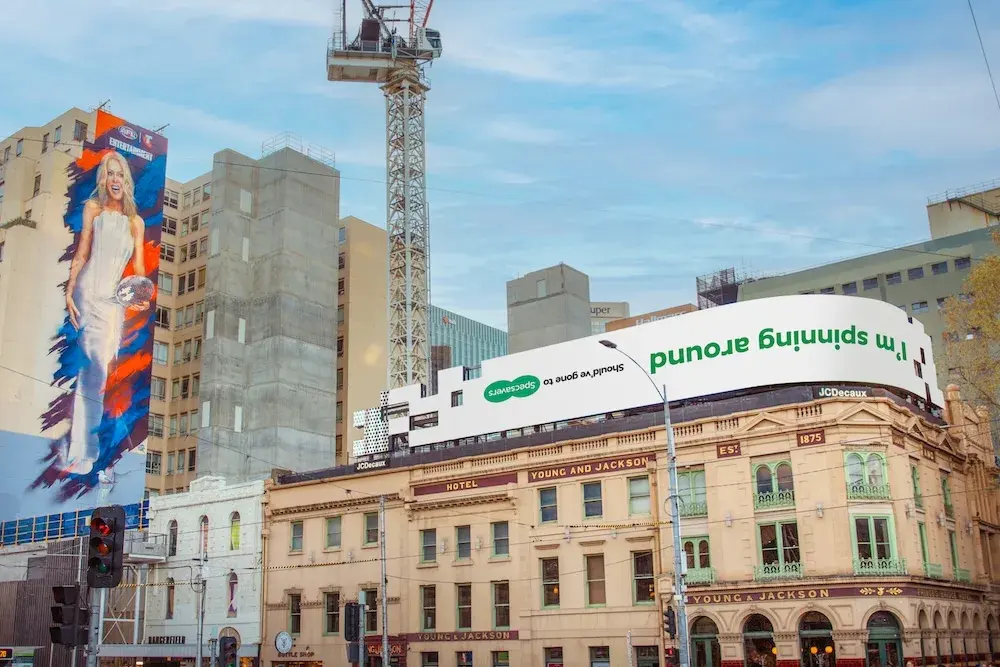
Specsavers has announced Melbourne outdoor activity built around Kylie Minogue’s Spinning Around reference for AFL Grand Final day. Campaign Brief’s 25 September report credits TBWA\Melbourne with creative and EssenceMediacom with media.
What the campaign plan includes
The report describes large-format and street-furniture placements, plus a roaming digital billboard across Melbourne’s CBD, Richmond and Punt Road. The JCDecaux Young & Jackson site beneath the Kylie mural is among the named locations.
The execution draws on Specsavers’ existing brand platform and designer relationship with Kylie. Campaign Brief describes planned Grand Final-day activity, rather than an audited delivery record.
The AFL’s official information confirms the event date as Saturday, 26 September 2026, at the MCG.
A cultural reference needs a brand connection
BillboardGuide’s analysis: The campaign’s useful creative principle is the connection between a timely reference and an established brand idea. The event provides a reason for the message to appear at that moment; the familiar brand platform gives viewers a route to understanding who is speaking.
For another advertiser, borrowing a cultural reference is only the start. Ask whether the joke or idea remains understandable to someone who sees the artwork briefly. The brand should be identifiable without requiring a detailed explanation of the event context.
Our OOH creative checklist supports that review, including readability and the clarity of the main idea.
Fixed and mobile placements play different roles
A fixed face provides a known position and sightline. A mobile display depends on the route, operating period and access conditions. They can support the same idea, but they need separate delivery definitions.
For a comparable event campaign, map the fixed assets and identify what the mobile component is intended to add. Define the permitted route and how the operator will document it. Avoid treating a proposed journey as guaranteed exposure at every point along it.
BillboardGuide’s mobile billboard truck guide explains the buying and operational questions to resolve for routed displays.
Event timing makes delivery conditions important
A campaign tied to one day has a narrow window in which its context is useful. Confirm the campaign hours, creative approval deadline and contingency arrangements before committing to the activity.
The placement plan should account for access restrictions and changes to movement around the event. Buyers need to understand what happens if a mobile route becomes unavailable or a fixed display misses contracted playback.
For digital inventory, request the current specifications, spot length, loop structure and proof-of-play arrangements. Our digital billboard guide provides a framework for reviewing those terms.
How to document a moment-led campaign
Retain dated photographs, playback evidence and route reporting where relevant. Those records establish delivery; any claim about awareness, visits or sales needs a separate method and supporting evidence.
The scale of an event does not automatically establish the audience of a particular advertisement. Campaign impressions should relate to the actual units, operating hours and agreed estimation method.
The Specsavers plan is a timely creative example for the 26 September edition. Its value for other advertisers lies in how closely the message, brand and intended viewing moment fit together.
 Los Angeles
 Dubai
Dubai