
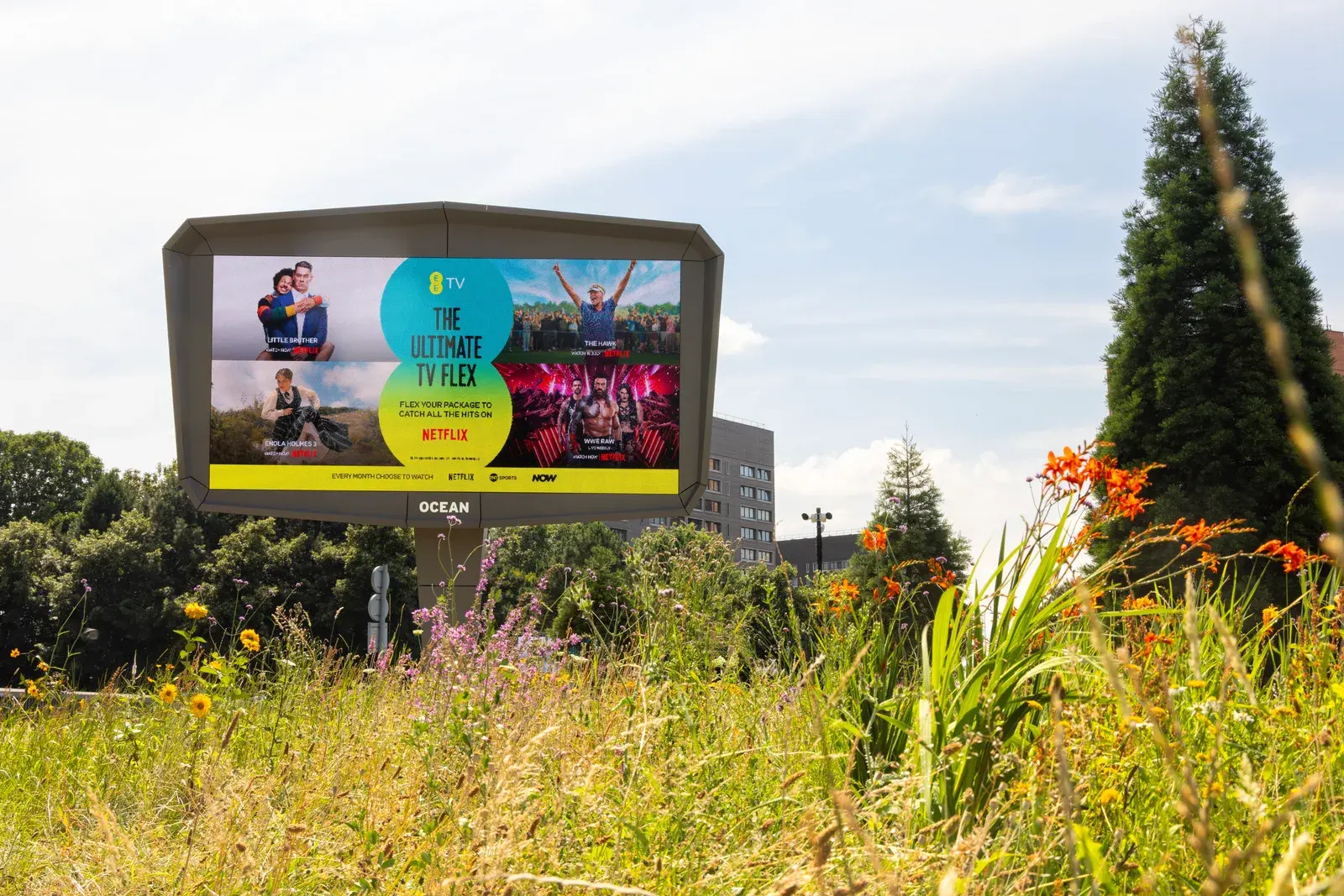

Ocean Outdoor has described a rewilding project around its advertising screens at Chester Road Roundabout in Manchester, turning previously grassed land into a flowering habitat. The company published its account on 21 September 2026 as part of a wider programme of work at its outdoor locations.
For advertisers and media owners, the development raises a useful question about the physical site: what happens to the land surrounding the screen, as well as the advertising displayed on it?
What Ocean reports at Chester Road
Ocean says landscapers worked on approximately one acre around three large-format screens, introducing more than 150 plant species. It describes further plans to use tree offcuts for insect habitats and says it is working to transform 21 outdoor locations, including sites in Scotland and other UK cities.
Those details are company-reported project information. The announcement describes planting and observations, rather than publishing an independent ecological impact study or a quantified campaign emissions assessment.
The site includes more than the display
Billboard Guide’s analysis is that the project puts estate management alongside media operation. An advertising location can include land whose maintenance affects both its appearance and its relationship with the surrounding area.
For a media owner, that introduces questions about who maintains the planting, how access to the display is preserved and how the work will be reviewed over time. The proposal for a landscape project should explain those responsibilities as clearly as a screen maintenance plan.
For an advertiser, site stewardship can be relevant when comparing suppliers. It adds information about how an operator manages its physical footprint, while the campaign still needs to be judged against the audience and creative brief.
BillboardGuide’s digital billboard guide provides broader context for evaluating the media itself, including viewing conditions and delivery requirements.
Habitat work and carbon accounting need distinct evidence
A planting project can be described accurately through its location, scope and maintenance arrangements. Claims about changes in wildlife or habitat quality require evidence suited to those outcomes, including a useful baseline and subsequent observations.
A campaign carbon claim asks a different question. It needs an assessment of the relevant emissions and a stated accounting boundary. The existence of a meadow beside a screen does not, by itself, establish a quantified reduction in advertising emissions or make a campaign carbon neutral.
That distinction helps buyers ask more precise questions. What has been completed at the site? Which outcomes have been measured? What separate information is available about screen operation and campaign delivery?
For related context, BillboardGuide retains an event guide on making net-zero OOH measurable. It records a past industry session and its topics; it is not verification of this project’s environmental impact.
Communicating the project without stretching the claim
An advertiser discussing the work should keep the language tied to documented facts. A description of an operator’s planting initiative is more useful when it identifies the site and explains what has changed there.
If the brand wants to make a broader environmental claim, it should establish what that claim covers and which evidence supports it. Supplier activity, campaign emissions and the advertiser’s own environmental commitments should be explained individually.
This approach also helps readers understand the story. Clear place names and a specific account of the work convey more than a general statement that outdoor advertising has become greener.
What to watch as the programme develops
The next informative evidence would be follow-up reporting on the planted sites, including maintenance and measured changes against an initial baseline. A wider programme would also benefit from clear records of which locations have completed work and which remain planned.
Ocean’s Manchester account is a tangible example of changing the landscape around outdoor media. Its longer-term significance will depend on how the habitat work develops and how the company documents the results.
 London