
Ocean Outdoor has announced a partnership with Cityz Media covering Klépierre’s 38 shopping centers in France, connecting mall advertising with Ocean’s creative production and brand-experience teams.
The 17 September 2026 announcement names Créteil Soleil and Val d’Europe in the Paris region, and Grand Place in Grenoble, among the destinations. Ocean Labs will support large-scale OOH and experiential productions, with design and production support from Ocean Studio.
The agreement also brings the Klépierre destinations into Ocean’s international sales network, The Alliance. Cityz Media’s own release dated 16 September places the partnership alongside its Klépierre contract renewal through 2034 and the creation of a dedicated Cityz Retail Media business unit.
The partnership combines media access with production
BillboardGuide’s interpretation is that the announcement concerns the relationship between a mall media estate and the teams developing experiences for it. An advertiser evaluating the opportunity should investigate both the inventory and the production service.
The proposal needs to identify the placement being purchased, the creative work included and who will approve the final execution. A standard screen campaign and a custom installation require different scopes, schedules and operating responsibilities.
BillboardGuide’s shopping mall advertising guide provides a reference for comparing the available environments. The partnership announcement does not replace a property-specific technical and commercial proposal.
Named malls provide a starting point for location research
The French portfolio should be assessed at destination level. A shopping-center package needs to show which properties serve the advertiser’s audience and where the message appears within each property.
For a retail launch, the team should connect the proposed malls with product distribution or participating stores. For an experiential campaign, it should establish whether the available space supports the intended interaction and visitor flow.
BillboardGuide’s Paris advertising guide provides wider regional context. The announcement identifies Paris-region destinations; buyers should retain the exact property addresses rather than describe every placement as being in central Paris.
Treat the installation and the screen as separate deliverables
A campaign combining a physical experience with supporting screens needs a clear description of each component. The build specification should establish the usable area, access, staffing and operating period. The digital plan should establish the booked units and playback commitment.
The creative review then needs to show how those components connect. Someone who sees only the screen should understand the brand and invitation. Someone approaching the installation should know what participation involves.
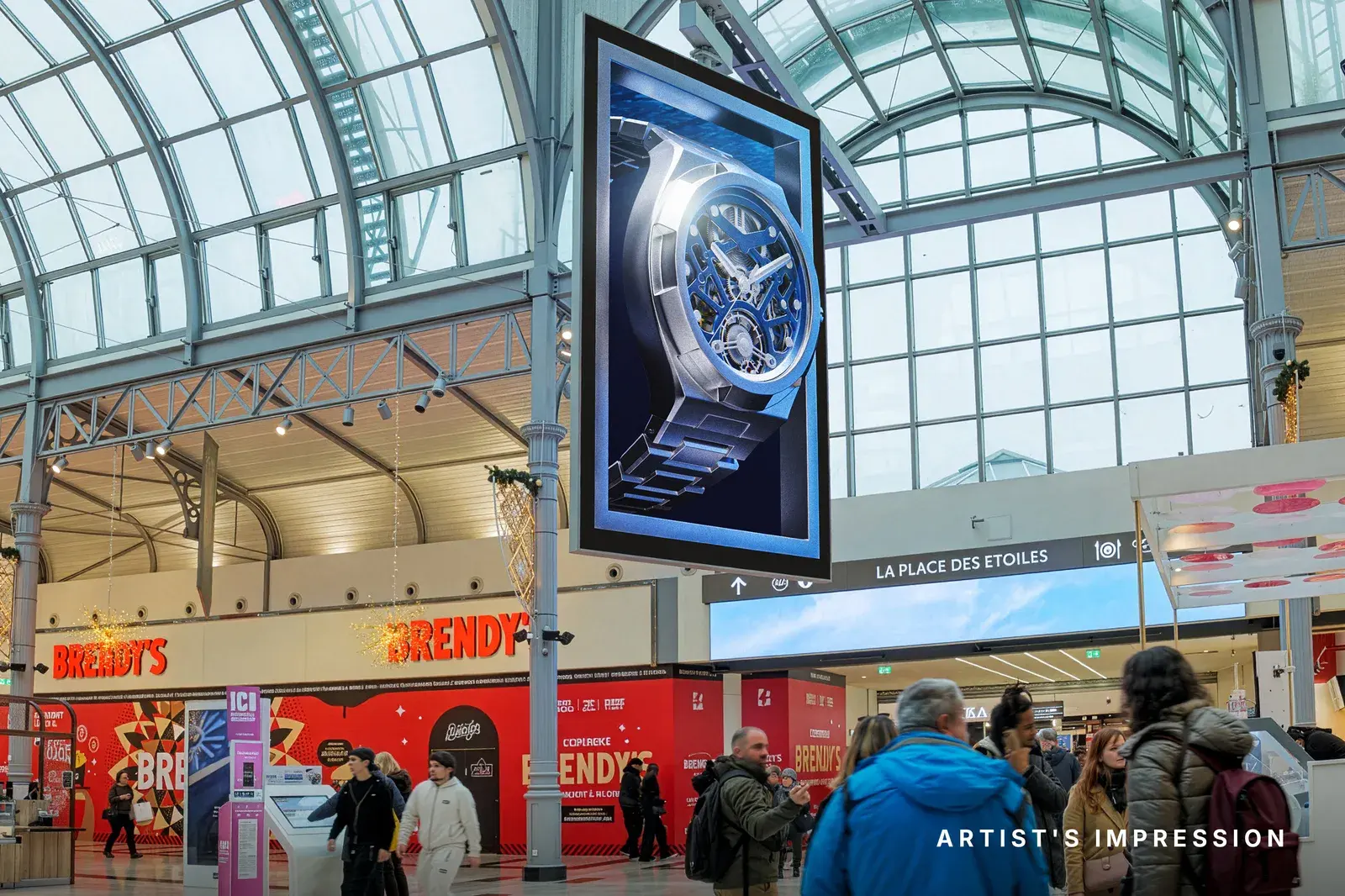
BillboardGuide’s experiential OOH installation guide offers further context for commissioning that physical element. A rendered concept image should remain clearly distinguished from evidence of a completed installation.
International access still needs local specifications
An international sales relationship may help coordinate a multi-market brief, but every destination still needs its own confirmed terms. The buyer should establish who contracts the media, who manages production and who handles reporting in each market.
A practical scope should include local artwork versions, approval deadlines and the conditions for changing a campaign after booking. Where several properties are involved, the reporting plan should preserve their individual delivery records.
These are suggested requirements for an advertiser’s brief, rather than a claim that identical booking terms apply across the partnership’s portfolio.
Define which result each component is intended to produce
For a screen campaign, the first reporting task is to verify delivery. For an installation, participation needs a clear definition and counting method. Any claim about changes in awareness, visits or sales requires additional evidence.
Combining the components does not justify adding screen impressions and event participants into one undifferentiated reach figure. The evaluation should explain what each measure represents and how overlap is treated.
BillboardGuide’s OOH metrics guide provides a framework for that distinction. The partnership offers a new production and coordination proposition for buyers to investigate, with campaign value determined by the actual locations, scope and delivery terms.
 London