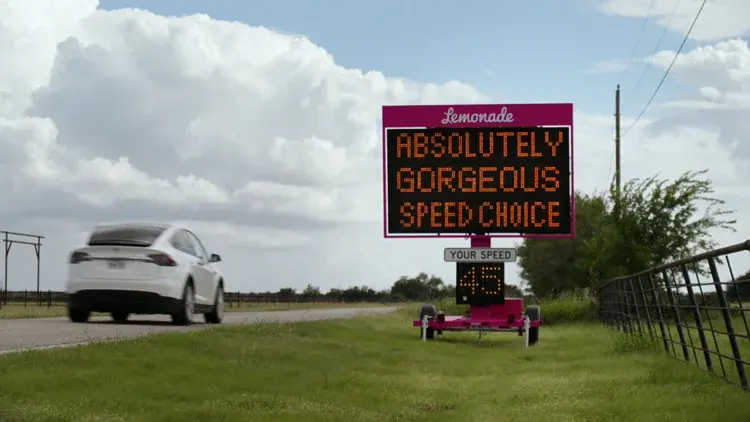

Insurance company Lemonade placed a bright pink digital sign beside a road outside Austin that responds differently depending on whether an approaching driver obeys the speed limit.
Speeding drivers see their speed on a radar display. Drivers within the limit can receive playful approval such as “Obsessed With Your Safe Driving” or “Way To Drive a Fast Car Slow.” The idea links the brand’s safe-driver pricing proposition to a real behavior occurring in front of the sign.
How the execution works
The human spotter is important. Coverage described the sign as identifying a vehicle’s color and make, but Fast Company reported that a person positioned down the road relayed those details using a walkie-talkie. The campaign should not be presented as automated computer vision or AI license-plate recognition.
- Location: Roadside outside Austin, Texas
- Brand: Lemonade
- Creative partner: Cash Studio
- Speed input: Radar speed display
- Trigger: Driver follows or exceeds the speed limit
- Personalization: A spotter identifies vehicle color and make by radio
- Safe-driver output: A playful compliment on the digital sign
- Speeding-driver output: Speed is shown; the compliment does not appear
Why the idea fits the brand
Dynamic OOH is most persuasive when the trigger explains the product. Lemonade says safer drivers can pay less for car insurance. Rewarding safe driving with visible praise makes that proposition physical and immediate.
The execution works on three levels:
Many dynamic campaigns change because data is available. This one changes because the data has a clear relationship with the brand.
- Behavior: it responds to an actual driving choice.
- Brand voice: the compliments use contemporary, playful language.
- Product relevance: the behavior is directly connected to the insurance offer.
The creative uses positive reinforcement
Road-safety signs commonly warn or punish. Lemonade’s concept instead withholds the entertaining part from speeding drivers and rewards compliant drivers.
That creates a simple reveal: drive safely and the sign comes alive. It also gives the campaign a story that can travel beyond the physical location through video, editorial coverage and social posts.
The earned-media value may exceed the number of people who directly pass the sign. Advertisers planning a similar execution should therefore budget for documentation—camera positions, releases, editing and social formats—not only the display.
Dynamic OOH needs a fallback state
A responsive sign must remain safe and understandable when the trigger fails. The media and production plan should define:
The default state should still communicate the brand. A blank screen or technical error can erase both the idea and the booked media value.
- Default creative when radar data is unavailable
- Maximum message length and display time
- Rules preventing a message from distracting drivers
- A moderation list for personalized copy
- Procedures when the wrong vehicle is identified
- Weather, power and connectivity contingencies
- On-site responsibility and escalation contacts
Personalization without unnecessary surveillance
The execution demonstrates that an idea can feel personalized without collecting an identity. Public coverage says the team used observable vehicle characteristics and a human spotter; it does not say the campaign identified drivers or retained license plates.
For other dynamic OOH campaigns, buyers should ask:
The best approach is often to use the least data necessary to create the effect.
- What data is collected?
- Is it anonymous, aggregated or identifiable?
- Is the data stored, and for how long?
- Does the creative expose information about an individual?
- Are notices or consent required?
- Has legal and privacy review been completed?
When contextual roadside creative is worth the complexity
A trigger is justified when it improves relevance enough to offset extra creative, data, approval and production costs. Otherwise, a strong static message may be more reliable.
- Automotive or insurance: Traffic, road conditions or safe behavior - Driving experience and protection
- Food and beverage: Weather or daypart - Immediate consumption occasion
- Travel: Live departures or destination conditions - Journey utility
- Retail: Store opening hours or local availability - Near-term visit opportunity
- Sport: Verified score or event stage - Shared live moment
- Public service: Environmental or safety condition - Timely behavior prompt
Questions to put in the media brief
These questions should be answered before the concept is sold internally as “real-time.”
- Which input changes the creative?
- Who owns and verifies that input?
- How quickly must the screen update?
- What happens when the input is late or wrong?
- Is manual supervision required?
- Does the media owner permit the execution?
- How will the campaign be photographed and measured?
- Which privacy and roadside-safety reviews apply?