
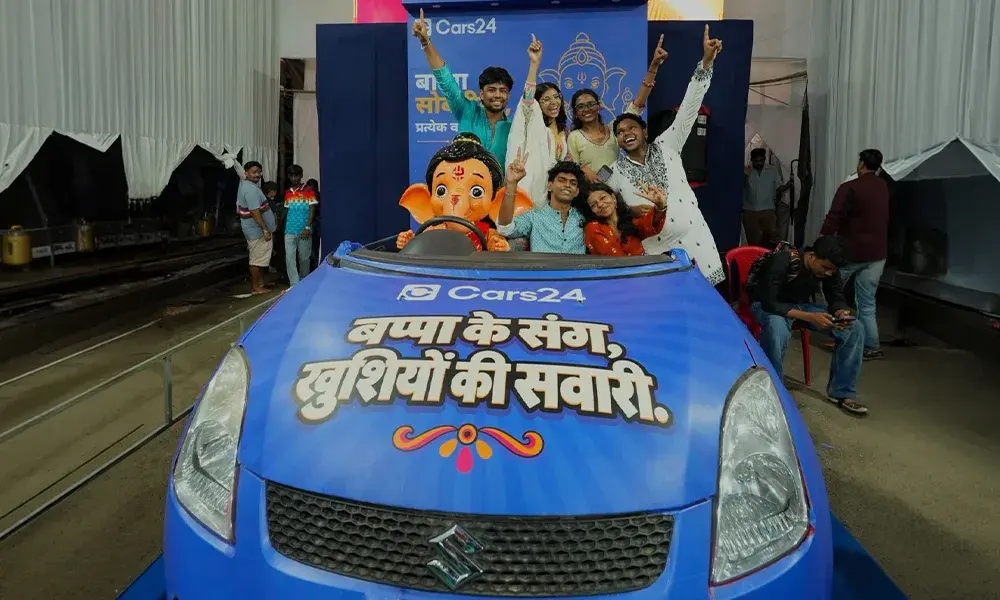

CARS24 has created a branded car installation at Khetwadicha Raja in Mumbai for Ganesh Chaturthi, giving visitors a place to interact and take photographs with a Ganesha figure positioned at the wheel.
Media4Growth’s coverage dated 16 September 2026 identifies the activation as “Bappa Ki Savari” and describes collaboration with Khetwadicha Raja. DOOH Digital’s same-day report also documents the vehicle-centered photo experience.
Media4Growth reports around 25,000 devotees participating on the first day. Its article does not explain the counting method, so that figure should be treated as a reported campaign claim rather than independently verified unique participation.
The product category becomes the physical experience
BillboardGuide’s interpretation is that the car gives the automotive brand a direct physical connection with the activation. The object carrying the brand is also the object around which visitors interact.
For another advertiser, that suggests a useful creative test: does the proposed build help people understand or remember the brand’s category? A photo opportunity becomes more commercially coherent when the object and the advertiser have a clear relationship.
The brief should also consider the image people take away. If a photograph crops out the brand, the experience may be remembered without an identifiable advertiser. Branding should work from the visitor’s likely camera position as well as from the wider site.
Festival context belongs in the creative review
An activation within a religious festival needs to fit the setting in which people encounter it. The organiser and people familiar with that setting should be involved in reviewing the concept, visitor interaction and presentation.
For a comparable brief, the review should establish where the installation sits, how it relates to the main event and what participation involves. The brand’s invitation needs to be understandable without interfering with why visitors came to the venue.
BillboardGuide’s event and festival advertising guide provides planning context for site rights and visitor environments. The CARS24 reporting describes a specific installation, rather than a verified citywide media rollout.
Participation changes the operational brief
A build that invites people to approach has different operational needs from an advertisement they simply pass. The site plan should account for people stopping, taking photographs and waiting for a turn.
For another campaign, the team should agree staffing positions, the usable interaction area and how to keep adjacent routes clear. It should also define when participation needs to pause and who can make that decision on site.
These are proposed planning requirements, rather than a description of CARS24’s operating procedures. BillboardGuide’s experiential OOH installation guide helps frame the relationship between site rights, build production and public interaction.
A branded car is not automatically mobile media
The presence of a vehicle does not establish that it travelled an advertising route. This story concerns the reported festival installation and its visitor experience.
BillboardGuide’s MARS Cosmetics vehicle campaign in Mumbai offers a separate vehicle-based creative comparison. The two examples should be evaluated according to their own placement and delivery models.
For advertisers considering a similar build, the distinction affects the proposal. A fixed installation needs a defined site and activation schedule. A moving campaign additionally needs a route and operating plan. Campaign imagery alone cannot confirm those commitments.
Measure encounters, participation and outcomes separately
An evaluation should define what counts as participation before quoting a total. People entering the interaction area, posing for a photograph and passing the installation describe different encounters.
Any subsequent brand-recall, enquiry or sales claim requires additional evidence. A photograph of a crowd cannot establish unique visitors or incremental commercial response.
The cited reporting provides no independently verified sales-lift figure. BillboardGuide’s guide to OOH metrics beyond impressions explains how to connect campaign objectives with appropriate evidence.
For planners, the installation provides a concrete example of an automotive object becoming a visitor experience. The transferable lesson is to develop the creative, camera view and participation plan together, then evaluate the result against a clearly defined objective.
 Chicago