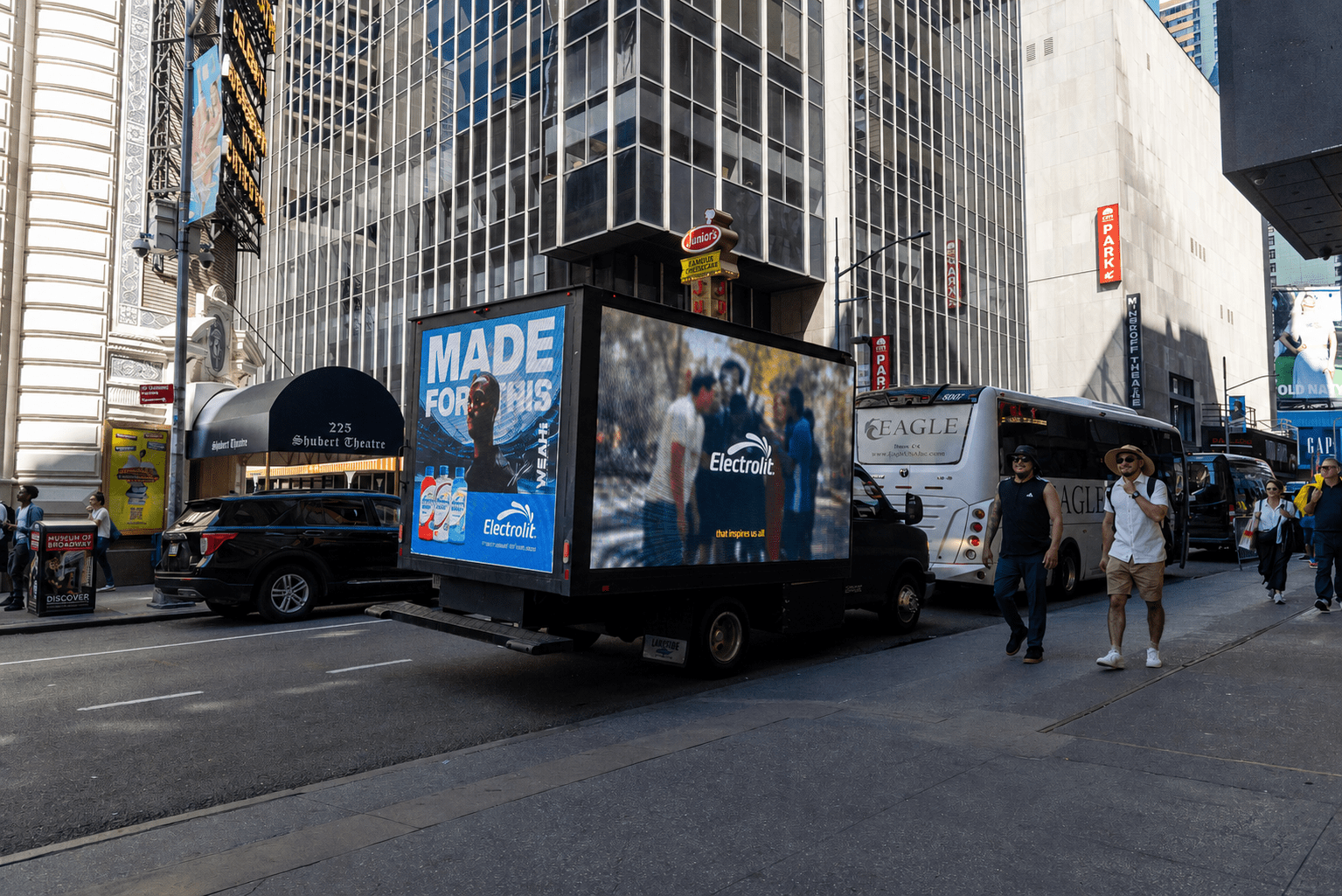

Electrolit deployed mobile LED billboard trucks in New York, Los Angeles and Dallas–Arlington during the 2026 World Cup, using routes that could follow fan activity rather than relying entirely on fixed placements.
Lime Media, the operator behind the execution, reported 629,220 physical impressions across eight activation days. The case shows why mobile OOH can be valuable around events—but also why the format should be evaluated as an operation, not merely as a screen attached to a vehicle.
Campaign facts reported by Lime Media
The campaign ran between June 12 and July 19 with agency partner Dash Two. Reported route areas included the Hollywood Walk of Fame in Los Angeles, pedestrian zones near New York fan-festival crowds, and areas around Globe Life Field and Reunion Tower in the Dallas region.
Lime Media described an average above 83,000 impressions per activation day and said the lowest-performing day in each market still exceeded 60,000 impressions. These are operator-supplied results and were not presented with an independent audit in the source article.
- New York: 4 - 4 - 258,220
- Los Angeles: 3 - 2 - 184,810
- Dallas–Arlington: 4 - 2 - 186,190
- Total: — - 8 market-days - 629,220
Why the format matched the event
A fixed billboard is selected because the expected audience will pass it. A mobile billboard reverses the decision: the display can be routed toward the expected audience.
That flexibility is particularly relevant when:
For a hydration product associated with sport and recovery, the format also created contextual fit. Electrolit was not only present in a host city; it attempted to appear where tournament energy and relevant consumer need were concentrated.
- Fan activity moves between stadiums, fan zones, nightlife and sponsor events
- Kickoff times and matchups change crowd concentration
- Weather affects outdoor gatherings
- A brand needs coordinated appearances across several neighborhoods
- The objective includes street-level visibility or social content
“Mobile” does not mean improvised
The campaign’s reported consistency depended on preparation. A route cannot simply chase a crowd without considering permits, vehicle restrictions, staging, driver hours, screen brightness, safe stopping areas and event security.
A credible mobile OOH plan should include:
Without those elements, mobility can become inefficient circulation rather than audience-led media.
- Primary and fallback routes. Each activation needs alternatives for road closures, congestion and crowd changes.
- Timed waypoints. The truck should reach important areas before audiences disperse.
- Geofenced proof of movement. GPS logs should confirm where and when the asset operated.
- Creative scheduling. The message may need to change by city, match, daypart or event stage.
- Operational contacts. Local teams need authority to respond when conditions change.
- Measurement rules. The advertiser should know how impressions are modeled from the route and what counts as delivery.
When mobile LED trucks are strongest
The format is less suitable when a campaign primarily needs long-term local frequency at the lowest possible cost. A well-positioned static or digital billboard may outperform a truck on sustained presence.
- Major-event presence: Routes can follow changing crowd zones - Access restrictions may prevent close stadium proximity
- Product launch: A visible asset can move between high-priority neighborhoods - Short activations may deliver limited frequency
- Retail opening: The route can connect awareness with store proximity - Road traffic does not guarantee store visits
- Experiential campaign: Trucks can support sampling or a physical activation - Staffing and permitting add complexity
- Multi-city tour: Standard creative can travel across markets - Consistent local execution requires strong logistics
- Tactical response: Digital creative can be changed quickly - Last-minute changes still require approvals and connectivity
How to compare mobile and fixed OOH
Do not compare the formats on CPM alone. A mobile campaign includes routing, vehicle operation and production that do not map neatly onto a fixed panel.
Ask each plan to show:
Then decide which role mobile OOH plays. It may be the central event asset, a tactical layer around fixed inventory, or an experiential support channel.
- Total operating hours and number of vehicles
- Expected route coverage by market
- Screen size, brightness and viewing sides
- Stationary versus moving time
- Share of voice and creative rotation
- Permits, staging and event-access assumptions
- GPS proof, photography and impression methodology
- Weather, mechanical and route-disruption contingencies
A sample event-media structure
An event plan could allocate roles rather than treating every placement as interchangeable:
This structure protects the campaign if one route or event site underperforms.
- Citywide reach: transit and selected roadside formats
- Event dominance: premium screens near official gathering points
- Flexible audience pursuit: LED trucks during peak movement windows
- Retail conversion: screens and posters near stores or hospitality partners
- Measurement: GPS delivery, digital play logs and location-based outcome analysis where appropriate
 London