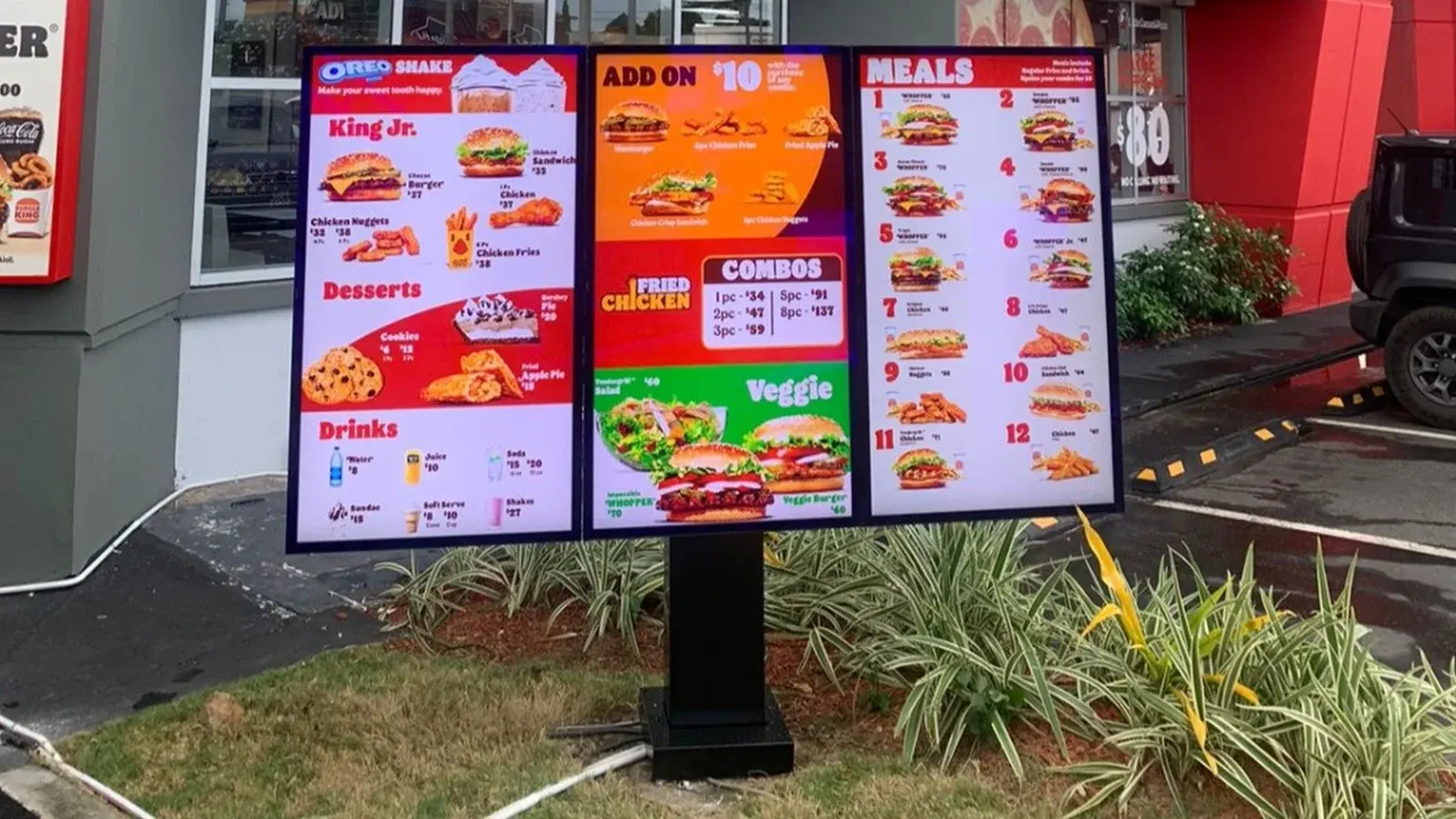

Palmer Digital Group has been selected as an approved supplier of outdoor digital menu-board systems for eligible Burger King franchisees across the United States and Canada.
The agreement is a digital-signage rollout, not an announcement that thousands of Burger King screens are immediately available to outside advertisers. That distinction matters as retail media, place-based DOOH and owned customer-experience screens increasingly overlap.
What has been announced
Franchisees can reportedly choose professional installation or self-install after online training. The modular approach is intended to make installation and maintenance easier, although actual cost, uptime and operational performance were not disclosed in the announcement.
- Supplier: Palmer Digital Group
- Customer base: Eligible Burger King franchisees in the U.S. and Canada
- Systems: Single- and triple-panel outdoor digital menu boards
- Display configuration reported: LG 49-inch outdoor displays in modular enclosures
- Orders reported: About 18
- First market: Wisconsin
- Target by end of Q3 2026: Roughly 30 operating locations
- Target by end of 2026: Approximately 50 locations
- Potentially eligible restaurants: Approximately 6,000
When owned signage becomes retail media
For a screen estate to function as a third-party advertising product, the operator needs more than displays. It needs:
None of those capabilities should be assumed from the supplier agreement alone.
- A commercial policy describing which advertisers are accepted.
- An ad-serving or content-management workflow.
- Defined inventory, loop rules and share of voice.
- Audience and transaction measurement.
- Brand-safety and category-exclusivity controls.
- Sales, billing and reporting processes.
- Clear separation between menu information and paid content.
Why the rollout still matters to OOH buyers
The announcement reflects a larger trend: more commercial environments are becoming addressable digital surfaces. QSR drive-throughs combine repeat visits, dwell time, purchase data and a clear physical context.
If a restaurant network later offers external media, the buyer should ask whether the screen is visible only after a customer enters the lane or also to passing traffic. The answer changes the audience, creative and measurement model.
An advertiser planning a restaurant campaign may need several of these roles, but they should not be priced or measured as if they are identical.
- Menu board: Customers in the ordering journey - Increase conversion and basket size
- Pre-sell board: Customers approaching the order point - Build consideration before ordering
- Roadside sign: Passing traffic and arriving customers - Awareness and location identification
- Indoor digital screen: Dine-in and waiting customers - Promotion, entertainment or partner messages
- Off-premise billboard: Broader local population - Reach, frequency and store visitation
Questions for brands considering QSR media
The strongest retail-media proposition connects verified screen delivery to a credible business outcome. Footfall and transaction data can help, but only when the methodology and controls are clear.
- Is third-party advertising actually permitted?
- Which locations and screen types are included?
- What is the average dwell time and audience methodology?
- Can the advertiser target by store, daypart or product availability?
- Are sales-lift studies available using privacy-safe transaction data?
- What portion of the loop is commercial advertising?
- Are competitive food, beverage or delivery categories restricted?
- How are outages and incorrect content handled?
How to use conventional OOH around a QSR rollout
Owned screens reach customers already on site. OOH can create demand earlier in the journey:
The plan should distinguish store conversion media from market-building media and assign measurement accordingly.
- Roadside billboards near restaurant clusters
- Commuter DOOH during meal dayparts
- Directional formats near exits and retail corridors
- Mobile or event media around limited-time launches
- Programmatic DOOH activated by time, weather or local availability