
Summary
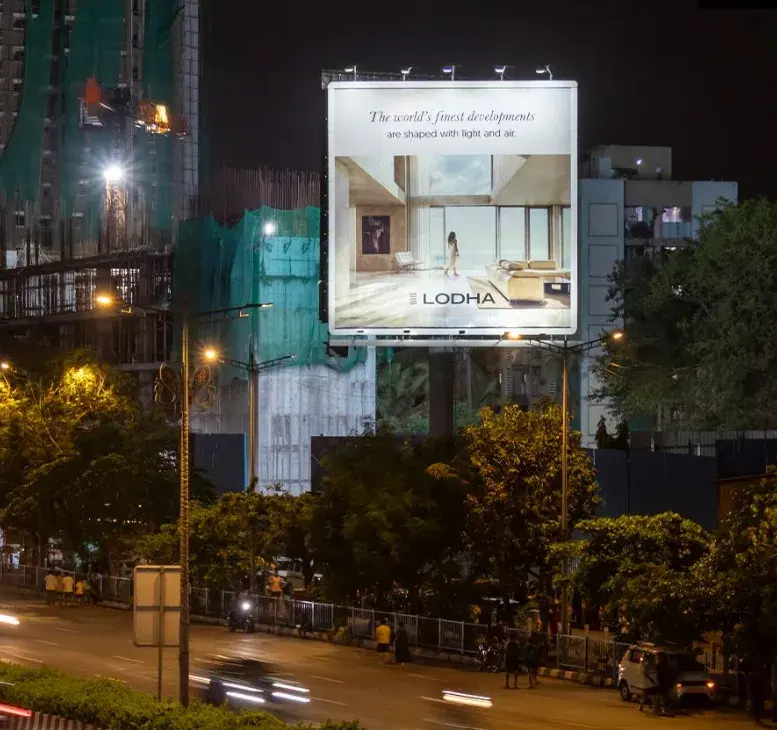
Lodha used large static and digital billboards along Mumbai’s Western Express Highway, demonstrating how premium real-estate brands can focus media around a high-value commuter corridor.
What happened
Lodha used large static and digital billboards along Mumbai’s Western Express Highway, demonstrating how premium real-estate brands can focus media around a high-value commuter corridor.
The campaign uses both static and digital billboard formats. The Western Express Highway is one of Mumbai’s major north-south transport corridors.
The story is relevant to Billboard Guide because it sits at the intersection of physical location, audience movement and media execution. OOH performance is rarely explained by format alone. The same creative can behave very differently depending on the street, station, venue, route, dwell time, competitive clutter and frequency of exposure around it.
Key facts for advertisers and media planners
These details should be read as campaign or market evidence rather than as a universal benchmark. Availability, pricing, audience methodology, rotation rules and specifications vary by operator and market. Buyers should confirm the current commercial terms directly with the media owner or its authorized sales partner before using any figure for a live media plan.
- The campaign uses both static and digital billboard formats.
- The Western Express Highway is one of Mumbai’s major north-south transport corridors.
- The media strategy emphasizes repeated commuter visibility rather than a one-off landmark placement.
What advertisers can learn
For SEO and AI-search users researching this topic, the most useful takeaway is the connection between the named company or campaign and its real-world geography. In OOH, geography is not metadata: it is part of the product. The route, district, city, venue or country affects who can plausibly see the message, how long they can see it, and what the surrounding environment communicates before the ad itself is processed.
- Real-estate OOH should map the buyer journey geographically: home, work, airport, premium retail and the development itself can all influence route selection.
- Digital sites can carry changing messages by phase—launch, price, construction milestone or call-to-action—while static sites provide persistent presence.
- Repeated corridor coverage can build familiarity, but planners should check duplication so multiple boards add incremental reach rather than only frequency.
Planning questions to ask before buying similar media
A comparable campaign should start with five practical questions. First, what job is the placement doing: broad reach, repeated commuter frequency, fame, proximity, launch impact or an experiential moment? Second, which audience movement pattern makes this location relevant? Third, is the creative legible at the actual viewing speed and distance? Fourth, what proof-of-play, posting evidence or audience reporting will be available? Fifth, does the format require special production, approvals, content moderation, brightness limits, engineering or other operational work?
Answering those questions before selecting inventory helps avoid a common OOH mistake: buying an impressive site without defining why that site is strategically useful.
What to watch next
Mumbai’s dense roadside market will keep rewarding brands that combine premium scale with disciplined route planning and short, legible property messaging.
The broader direction is toward OOH plans that connect media quality with clearer audience logic. Digital screens make timing and creative changes easier, special builds can make campaigns more memorable, and better data can improve planning—but none of those advantages replaces the need to understand the physical place.