

30 September 2026 edition | Bengaluru, India
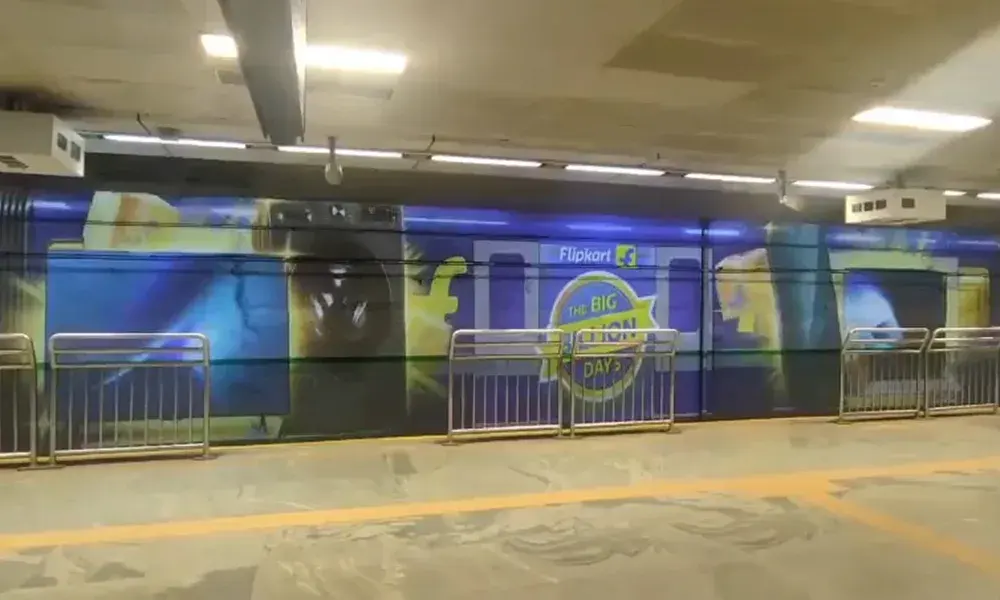
Flipkart has used projection at Bengaluru’s Majestic Metro Station to create the illusion of a branded train arriving, turning the station setting into part of its Big Billion Days campaign idea.
Media4Growth’s report, published 28 September, describes an execution on the wall opposite the platform. It credits 22feet with the creative concept and Signpost India with the out-of-home execution.
The train in this execution is a projected visual illusion. The report describes a campaign that uses the surroundings to suggest an arrival; it does not establish that an actual metro train received a Flipkart wrap. That distinction matters when describing the production technique or comparing it with other transit advertising formats.
The station supplies the creative context
BillboardGuide’s analysis: A familiar setting can help an audience understand an unusual execution. Here, the idea of a train arriving belongs naturally to the place where the advertising appears. That relationship gives the projection a clear creative premise.
For another brand, the lesson is to identify the behaviour or expectation associated with a venue before selecting an effect. An execution built around that context can be easier to interpret than a spectacular visual with no obvious connection to the surroundings.
Projection, digital displays and vehicle advertising have different production and buying requirements. BillboardGuide’s OOH formats guide provides a starting point for comparing the role of a proposed placement within a wider campaign.
Keep the brand legible during the effect
An arrival illusion may attract interest, but the campaign still needs to communicate who is speaking and what the audience should remember. The brand, product or event name should remain clear at the moment when the visual attracts attention.
Test the sequence from several realistic viewing positions. Check whether people entering halfway through can understand the idea, and whether the essential message survives obstructions or a short viewing opportunity.
BillboardGuide’s creative checklist can support that review. For projection specifically, the production team should also validate the surface, light conditions, alignment and final playback on site. Those are planning recommendations, rather than additional claims about the equipment used in this campaign.
Assess the activation and its wider reach separately
A distinctive transit execution can generate material for social posts and campaign coverage. On-site exposure and online distribution should nevertheless have separate reporting, with clear definitions for each metric.
Request delivery records for the physical activation and track digital reach through the channels where the content appears. If the campaign seeks a commercial response, establish a suitable evaluation method before launch. A video of the effect demonstrates the creative treatment; it cannot independently establish sales uplift or unique station audience reach.
For another Indian urban campaign reference, read BillboardGuide’s coverage of Foxtale’s billboards in Mumbai, Bengaluru and Delhi. The useful comparison is how each brand connects its message to a physical setting and a wider communications plan.