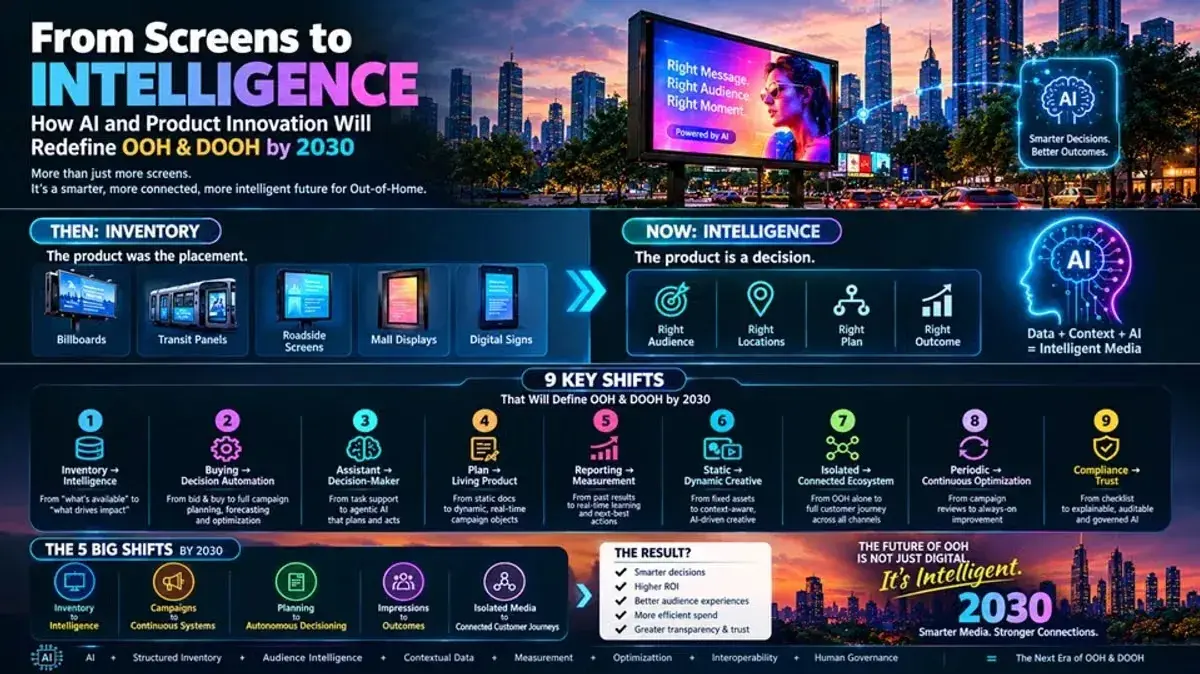

Moving Walls has published a 2026–2030 strategy paper describing its approach to connecting outdoor media planning, activation and measurement through a software layer that works with existing content-management and buying systems.
The company article dated 15 September 2026, by product manager Suraj Prakash, positions automation around campaign decisions as well as transactions. It describes a measurement framework spanning impressions, reach and frequency, engagement, and sales or other outcomes.
Moving Walls also distinguishes AI reasoning from the deterministic systems handling pricing, budgets, contractual rules and impression calculations. These are the company’s stated architecture and product-positioning claims, rather than an independent evaluation of performance.
Turn the strategy into a workflow demonstration
BillboardGuide’s interpretation is that the useful buyer question is what changes in a real campaign workflow. A platform demonstration should take a defined brief through the steps an agency or media owner actually performs.
Start with a specific audience, geography, budget and period. Ask the supplier to show how inventory becomes eligible, how the proposal is produced and what information remains available when the campaign is activated.
The demonstration should also include a change to the brief. If the dates or budget change, the user needs to see which commitments can be altered and which require approval. This gives the buyer a concrete basis for assessing the product beyond a broad promise of automation.
Existing systems make integration a commercial question
For a media owner, integration needs to respect the way inventory is already sold and operated. A proposal should show which system holds availability, which records bookings and how conflicting requests are handled.
For an agency, the corresponding concern is whether the platform can reconcile the proposed plan with the delivery report. The campaign identifier, asset list and creative versions should remain traceable through the workflow.
BillboardGuide’s earlier reporting on Moving Walls and BrightSign provides context for its existing-screen proposition. The strategy paper is a broader company position, rather than a new confirmation that every integration is available to every customer.
Test decisions with known scenarios
A procurement team can prepare a small set of scenarios before evaluating planning software. Each should have an expected commercial boundary, so the demonstration reveals how the platform handles it.
- A screen becomes unavailable — Updated plan and treatment of committed delivery
- The budget is reduced — Revised allocation and an explanation of affected commitments
- Creative approval is delayed — Clear campaign status and treatment of the original start date
- Audience data is missing — An identified limitation and the basis of any fallback estimate
These are BillboardGuide’s suggested evaluation scenarios, not test results for Moving Walls. They help establish whether a decision can be understood and reviewed by the people responsible for the campaign.
Match each measurement layer with evidence
Connecting reporting with planning requires more than putting several metrics in one dashboard. The buyer needs to know where each metric comes from and what it can support.
For a platform review, ask how playback records, modeled audience estimates and outcome research are distinguished. A change in a modeled number should not silently become a claim about additional customers or sales.
BillboardGuide’s OOH metrics guide offers a framework for keeping those evidence types clear. A procurement brief should also define how users can export the underlying campaign report and investigate a discrepancy.
Define the human decision points
An automation brief should state which actions the system may take within agreed limits and which require a person to approve a change. The commercial owner needs a usable record of what changed and why.
That review process belongs alongside the inventory and delivery requirements. BillboardGuide’s programmatic DOOH guide provides further buying context, while its media planning service can help advertisers define the campaign requirements a platform must satisfy.
The strategy paper gives agencies and media owners a proposition to examine. Its practical value for a buyer will depend on demonstrated workflows, supported integrations and evidence from the buyer’s own requirements.