The landmark guidePublic Squares & Crossings
Sankofa Square Screens Landmark advertising guide
Sankofa Square, Toronto
Plan Sankofa Square Screens advertising: audience, inventory, booking routes, creative guidance, risks and current source links.
- Environment
- Public Squares & Crossings
- Location
- Sankofa Square, Toronto
- Buying route
- Current asset owner/operator, property partner or specialist OOH agency

Quick answer
Sankofa Square combines bookable public-space activations with surrounding commercial billboards owned by neighboring properties. The square's own digital displays are not a normal commercial ad network, so media and event rights must be sourced separately.
Location & surroundings
Explore Sankofa Square, Toronto and the surrounding streets. Use the map to review the setting and nearby approaches.
Location
Sankofa Square, Toronto- City
- Toronto, Canada
- Region
- North America
- Environment
- Public Squares & Crossings
- Coordinates
- 43.65611, -79.38028
- DMS
- 43°39'22.0"N 79°22'49.0"W
Drag to pan, scroll to zoom, right-drag to orbit.© Mapbox© OpenStreetMap
Site reference
- City
- Toronto, Canada
- Region
- North America
- Site type
- Public-square activation and surrounding multi-owner screens
- Market structure
- Public-square activation and surrounding multi-owner screens
- Best for
- Canadian launches, entertainment, retail, student and community-relevant campaigns with an experiential component.
- Pricing
- Quote-only; request media, production, technology, rights and taxes as separate lines
What makes Sankofa Square Screens distinctive?
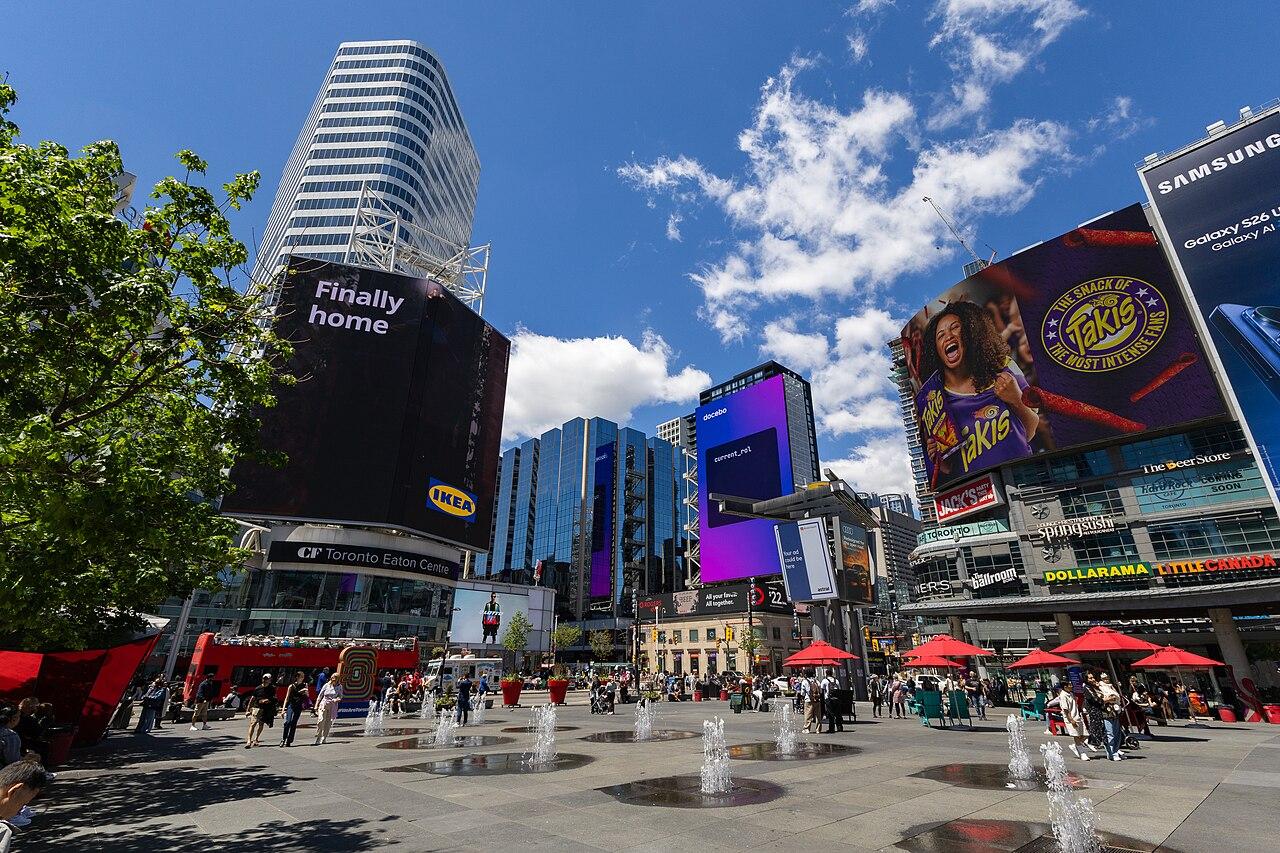
A pedestrian scramble, subway access, shopping, education and entertainment venues create high dwell at a compact civic square. Surrounding façades provide the visual advertising environment.
The planning advantage is recognisability: a campaign can communicate *where it ran* in a single photograph. That does not make every face equally effective. Sightline, dwell, visual competition, operating hours and the ability to document the execution determine whether the location earns its premium.
Audience context
Downtown workers, students, shoppers, event audiences, residents and visitors mix throughout the day. Events can transform flow and available footprint, making the calendar as important as average pedestrian counts.
Ask the seller to separate people present, opportunities to see and measured impressions. Useful evidence includes unit-level methodology, daypart and day-of-week delivery, seasonality, dwell, direction of travel and the date of the study. For a launch, also estimate the secondary audience reached through press, creators, brand channels and partner distribution; keep that earned reach separate from the media impression forecast.
Inventory and ownership structure
The square manages its event space and community-oriented digital signage. Its official guidance says advertisements are not sold on the square's own screens; surrounding commercial boards are controlled by neighbors and media owners such as Astral/Bell or property-specific sellers.
Before comparing prices, normalize each proposal into the same fields:
- exact asset name, address, coordinates and current photograph;
- owner, contracted seller and any intermediary;
- visible dimensions, pixel dimensions and primary sightline;
- loop length, spot length, plays per hour and effective share of voice;
- operating hours, illumination and audio conditions;
- campaign dates, event conflicts, maintenance and blackout rules;
- audience source, proof-of-play and make-good policy;
- included production, adaptation, installation, testing, permits and taxes.
How to book Sankofa Square Screens
Book an activation through Sankofa Square's official venue route. Buy surrounding screens directly from their current owners or through a Toronto OOH specialist. Align the contracts, exact hours, event permits, staffing, power, sampling rules and screen content.
- Write a one-page objective. State audience, dates, desired landmark value, required photographs/video and whether an activation is part of the idea.
- Identify the exact asset. Do not accept a neighborhood label without an address, face and travel direction.
- Request a current technical and commercial pack. Include all fields above and ask when the unit was last photographed.
- Hold the dates conditionally. Make the hold subject to creative feasibility, approvals, rights and a satisfactory site check.
- Preflight the creative. Use native templates and an operator simulation; obtain written content approval before final rendering or print.
- Document delivery. Agree proof-of-play, posting photographs, outage reporting, make-goods and the deadline for the final campaign report.
Cost and commercial terms
Iconic-location pricing is usually negotiated and highly date-sensitive. A useful budget separates media, creative adaptation, 3D or motion production, technical testing, print/installation, permits, event space, filming/photography, talent/music rights, agency fees and taxes. A headline weekly or daily figure without these inclusions is not comparable.
Ask for a current written quote in the campaign currency and state whether it is gross, net or agency-commissionable. For digital media, translate every package into effective share of voice and total scheduled plays. For static media, confirm the posting period, production ownership, weather replacement and removal. For a takeover, define whether competing screens, house content or emergency messages can interrupt the moment.
Creative specifications and production guidance
Design for pedestrians at close and medium range. If pairing an activation with screens, use a single visual cue and timed call-to-action; do not assume frame-perfect synchronization across separate owners.
Use the operator's current specification as the controlling document. A planning render is not a delivery template. Check file codec, frame rate, maximum luminance, safe zones, copy duration, legal text, content restrictions and local language needs. Allow additional lead time for anamorphic 3D, live data, broadcast feeds, interactivity or synchronization.
- Can the brand be identified in two seconds without sound?
- Is the smallest important type legible from the real viewing distance?
- Does the final brand frame hold long enough to photograph?
- Does the idea still work outside the ideal 3D viewing cone?
- Are claims, prices, talent, music and cultural references cleared locally?
- Is there a static or conventional-motion fallback?
Best campaign uses
Canadian launches, entertainment, retail, student and community-relevant campaigns with an experiential component.
The location is less suitable when the brief needs narrow audience precision, direct-response efficiency without a wider fame objective, or rapid creative changes without local approval time. In those cases, use the landmark as a short hero layer and place the majority of reach in a broader, measurable OOH or DOOH network.
Measurement framework
Set measurement before booking. A practical scorecard combines:
Use a campaign-specific URL or search term in surrounding media, but avoid making a roadside QR code the primary success metric. The business case for an iconic site often blends measured local exposure with content value and organizational signaling; report those components separately.
- contracted delivery: plays, SOV, posting compliance and outages;
- audience delivery: operator-rated impressions with methodology and dates;
- attention proxies: dwell, completion opportunity and viewability studies where available;
- response: search lift, direct traffic, QR/NFC only where safe and usable;
- location signals: consented visitation or exposed/control analysis where lawful;
- brand effects: awareness, consideration or message association study;
- amplification: earned media and social video, deduplicated where possible.
Risks, permissions and practical caveats
The square was renamed from Yonge-Dundas Square. Use both names in discovery metadata, but use the current official name in copy. Never imply the public square sells advertising when the purchase is actually on a neighboring building.
Also confirm brand-safety adjacency, political or public-service interruption rules, weather and power resilience, construction obstruction, local privacy law for sensors, accessibility, insurance, and who carries responsibility for public-realm operations. If the campaign depends on a photo or video of the landmark, secure the necessary location, property, trademark, talent and music rights before launch.
Questions to ask the media owner
- What exact screen or face is being sold, and who owns and operates it today?
- What is the guaranteed spot length, plays per hour and share of voice?
- Which dates, events, maintenance periods or public messages can interrupt delivery?
- What audience methodology supports the estimate, and when was it updated?
- What creative formats are approved, and what is the final submission deadline?
- What proof, outage reporting and make-good terms are included?
- Which rights and permits are *not* included in the media price?
Planning checklist
- Write a one-page objective. State audience, dates, desired landmark value, required photographs/video and whether an activation is part of the idea.
- Identify the exact asset. Do not accept a neighborhood label without an address, face and travel direction.
- Request a current technical and commercial pack. Include all fields above and ask when the unit was last photographed.
- Hold the dates conditionally. Make the hold subject to creative feasibility, approvals, rights and a satisfactory site check.
- Preflight the creative. Use native templates and an operator simulation; obtain written content approval before final rendering or print.
- Document delivery. Agree proof-of-play, posting photographs, outage reporting, make-goods and the deadline for the final campaign report.
FAQ
Questions & answers
5 questions
Is Sankofa Square Screens one billboard or several?
It is best classified as a public-square activation and surrounding multi-owner screens. The inventory explanation above identifies whether the name refers to one controlled asset or a district assembled from multiple owners.
How much does advertising here cost?
There is no durable public price that covers all dates and products. Request a current written quote with SOV, production, rights, taxes and operator fees separated. Premium seasons, exclusivity, 3D production, live content and takeovers can change the total substantially.
Can the campaign use 3D or anamorphic creative?
Only when the specific screen supports it and the operator approves the production. Obtain the native geometry, designated viewing point, test process and flat fallback before committing to the concept.
Can we run a live event or public activation with the screen?
Possibly, but media rights and public-space rights are commonly separate. Confirm venue control, permits, security, crowd management, power, sound, insurance, filming and weather contingencies.
How early should an advertiser start?
Allow at least several weeks for a conventional digital campaign and materially longer for 3D, synchronized takeovers, static spectacular production or public activations. High-demand cultural and retail dates should be held earlier.
Sources
Source references
4 sources
- Sankofa Square: aboutsankofasquare.ca (opens in a new tab)
- Sankofa Square: digital signagesankofasquare.ca (opens in a new tab)
- Sankofa Square: book the squaresankofasquare.ca (opens in a new tab)
- Sankofa Square FAQsankofasquare.ca (opens in a new tab)
Pricing figures on this site are illustrative planning estimates, not quotes: rates vary by operator, market, availability, timing, and campaign requirements, so confirm current terms directly with the media owner before committing budget. Last updated .
Report a correctionYour next step
Plan a campaign at Sankofa Square Screens.
Share your dates, budget and campaign objective. Get help with the buying route, current availability and pricing for this location.
Check availability & pricingYour enquiry includes this location.