The field guideNorth America
San Francisco Billboard advertising guide
United States
Plan billboard advertising in San Francisco: districts, formats, transit, pricing factors, booking routes, creative and local rules.
- Market
- San Francisco, United States
- Currency
- USD
- Media landscape
- Roadside, transit, street furniture, property/place-based and airport where available

Quick answer
San Francisco combines a tightly regulated city core with transit-heavy BART media and major roadside opportunities across the wider Bay Area and Silicon Valley.
How the San Francisco outdoor advertising market works
I-80/Bay Bridge and US-101 are critical corridors, but much high-impact inventory sits outside San Francisco's municipal boundary. SoMa and downtown provide more contextual urban formats.
The essential planning distinction is between a city name used as a sales market and the actual municipal boundary. Operator market pages often cover a wider metro, commuter belt or media market. That can be useful for reach, but a plan should never describe suburban inventory as a city-centre presence without showing the map.
Advertising districts and environments
The Bay Area's transit is four systems, not one: BART, Muni, Caltrain and VTA are separate and may have different representatives. OUTFRONT markets substantial BART, Caltrain and VTA-related opportunities, so confirm the exact concession and station list. San Francisco's own conventional supply is tightly restricted, which pushes weight onto walls, transit and the peninsula corridors.
| San Francisco environment | Planning role | What the proposal must identify |
|---|---|---|
| Downtown / Financial District | Business, tourism, convention and commuter audiences | Station inventory versus surrounding street inventory |
| SoMa | Technology, conferences, nightlife and large wall opportunities | Wall permissions, posting cycle and city sign consent |
| Mission / Castro | Culture, local relevance and street-level media | Panel positions, posting cycle and local sign rules |
| I-80 / Bay Bridge approaches | High-volume East Bay commuter exposure | Face direction, travel side and illumination hours |
| US-101 / Silicon Valley | Technology workforce and peninsula journeys | Which jurisdiction applies, and face direction |
| BART, Muni, Caltrain and VTA | Rail, bus and commuter-rail coverage | Which system, which representative, and the station list |
| SFO | Airport audience | Terminal, passenger zone and separate airport buying route |
Environments, not a rate card. Ownership, concessions and permitted categories change; confirm every row against the current contract holder before booking.
Available billboard and OOH formats
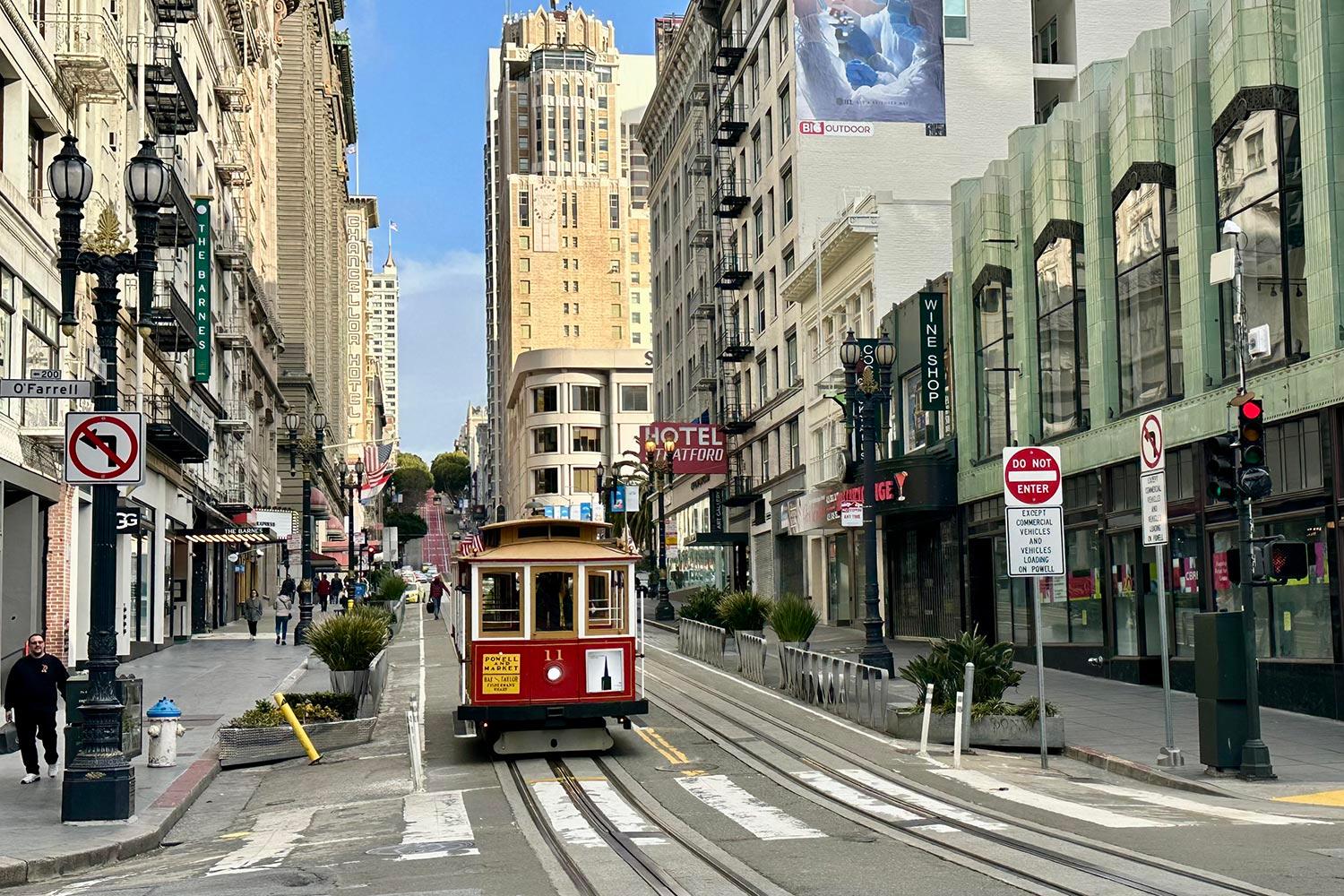
Billboards, walls, digital/static transit, station dominations, bus/light rail, airport and place-based screens are available. Core-city large-format supply is constrained relative to the broader region.
Transit advertising in San Francisco
BART, Muni, Caltrain and VTA are separate systems and may have different representatives. OUTFRONT markets substantial BART, Caltrain and VTA-related opportunities; confirm the exact concession and station list.
Transit should be specified by system, mode and environment. A proposal should state whether it includes vehicles, stations, platforms, interiors, exteriors, digital screens, wraps or dominations. Confirm accessibility, safety, content and installation rules with the authority's current representative.
How billboard pricing works in San Francisco
Downtown walls, Bay Bridge approaches, premium BART stations, airports and major tech-conference periods cost more. Distributed transit and regional digital networks can achieve scalable reach.
There is no durable citywide price because a 'billboard' can mean a neighborhood poster, freeway bulletin, ten-second digital slot, station domination or bespoke building façade. Request a live quote and normalize it into:
Use total campaign cost and expected delivery to compare proposals. A cheaper unit outside the required journey is not efficient; a premium unit can also be wasteful if landmark fame is not part of the objective.
- named unit, address, coordinates, face and travel direction;
- visible and pixel dimensions;
- campaign dates and guaranteed operating hours;
- digital spot length, loop, plays and effective share of voice;
- static posting cycle and included print/installation;
- audience source, impression period and methodology;
- creative adaptation, testing, permits, photography and technical fees;
- taxes, agency commission, cancellation and make-good terms.
How to book billboard advertising in San Francisco
Use OUTFRONT and other Bay Area owners for roadside/transit, then verify city/property inventory separately. Demand a map that distinguishes San Francisco, East Bay, Peninsula and South Bay.
- Define the journey. Identify the districts, roads, transit lines, venues and event dates that matter.
- Request a geocoded inventory list. Do not accept a city label, screenshot or operator logo as proof of location.
- Normalize commercial terms. Compare SOV, posting period, production, proof and taxes on like-for-like fields.
- Validate the site. Check dated photography, map orientation, obstructions, illumination and operating hours.
- Preflight creative. Use the current operator template and complete local content review before final production.
- Agree measurement and make-goods. Define proof-of-play/posting, outages, substitutions and final reporting in the contract.
Creative guidance
Sophisticated audiences do not excuse dense copy. Use a sharp proposition, strong typography and separate assets for station dwell versus freeway speed. Tech humor should remain understandable outside the category.
Every city plan should still follow core OOH discipline: one focal idea, immediate branding, short copy, large type and an identifiable call-to-action. Produce separate assets for highway, transit dwell, portrait street furniture, airport and irregular spectaculars rather than force one master file into every format.
- Can the brand be recognized in two seconds without sound?
- Is the smallest important text legible from the actual viewing distance?
- Does the layout survive bright daylight, night luminance and common obstructions?
- Are language, price, product and regulated-category claims locally cleared?
- Does motion avoid flashing or distraction limits?
- Is a static or conventional-motion fallback approved?
Seasonality and campaign timing
Conference calendars, Pride, major sports and holiday tourism affect demand. Fog, wind and rain influence visibility and posting; hybrid work makes weekday patterns especially important.
Reserve premium event inventory early and ask how the seller treats road closures, strikes, security events, weather and public-service interruptions. A make-good on a distant screen may not replace the value of a date-specific district.
Local regulations and practical risks
San Francisco sign rules are strict and Bay Area inventory is geographically dispersed. Confirm municipality, permit, current sightline, weekday delivery and whether a 'San Francisco' package is actually outside the city.
Also verify structural and electrical approvals, political advertising rules, alcohol/gambling/pharmaceutical restrictions, privacy rules for sensors or mobile data, public-decency standards, accessibility, insurance and filming rights. The signed current proposal and technical pack should control over this editorial guide.
Measurement framework
Audience claims for any row above should be tied to a date, unit and methodology. Ask sellers to separate population coverage, traffic circulation, opportunities to see and modeled impressions. Tourism, events, hybrid work, university calendars and commuting patterns can make a single annual average misleading.
A city campaign should report contracted delivery, not just operator reach. Use proof-of-play or posting photographs, outage logs and asset-level impressions. Where lawful and methodologically sound, add search lift, site traffic, store visitation, exposed/control analysis or brand lift. Keep earned/social amplification separate from measured OOH impressions.
For U.S. roadside media, ask whether Geopath ratings are available. In Canada use COMMB where applicable; the UK commonly uses Route; Australia uses MOVE. In other markets request the recognized local currency or an operator methodology with enough documentation to audit assumptions.
Questions to ask a media owner
- Which exact assets are inside San Francisco, and which are in the wider metro area?
- Who owns and operates each face or transit concession today?
- What is guaranteed: dates, plays, SOV, posting and operating hours?
- How were impressions calculated, and when was the input data updated?
- What production, permits, review, photography and taxes are excluded?
- Which events, maintenance or public messages can interrupt delivery?
- What proof and make-good remedy applies to every format?
Market reference
- City
- San Francisco, United States
- Region
- North America
- Country code
- US
- Planning geography
- City plus relevant metropolitan commuter market; verify every boundary
FAQ
Questions & answers
5 questions
How much does a billboard cost in San Francisco?
Costs vary by exact face, format, audience, dates, SOV, duration and production. Request current quotes from the relevant owners and compare all-in campaign cost. Public price ranges are useful only as early planning context.
What is the best area for billboard advertising in San Francisco?
There is no universal best district. The right area is the one that intersects the target audience's real journey and supports the campaign objective. Use the district and environment matrix above as a briefing framework, then validate current inventory against the named contract holder.
Are digital billboards available?
Digital inventory is available in at least part of the market, but its location and permitted behavior vary. Confirm motion, operating hours, loop, SOV, brightness and programmatic availability at screen level.
Can a small business advertise in San Francisco?
Yes. Local businesses can use neighborhood posters, transit, street furniture, place-based screens or tightly geofenced digital packages. Concentrated frequency near a real catchment usually outperforms a single prestige unit with insufficient repetition.
How far in advance should a campaign be booked?
Allow several weeks for conventional digital or standard static media and longer for wraps, walls, takeovers, regulated categories, custom builds and major events. Premium seasonal dates should be held earlier.
Sources
Sources & Methodology
4 sources
- OUTFRONT San Franciscooutfront.com (opens in a new tab)
- BART advertisingbart.gov (opens in a new tab)
- SFMTA advertisingsfmta.com (opens in a new tab)
- San Francisco sign permitssfplanning.org (opens in a new tab)
Pricing figures on this site are illustrative planning estimates, not quotes: rates vary by operator, market, availability, timing, and campaign requirements, so confirm current terms directly with the media owner before committing budget. Last updated .
Report a correctionCampaign planning
Plan your campaign in San Francisco.
Share your audience, dates and budget. A planning partner can confirm suitable formats, current availability and pricing.